Photo by Mariem Yadir
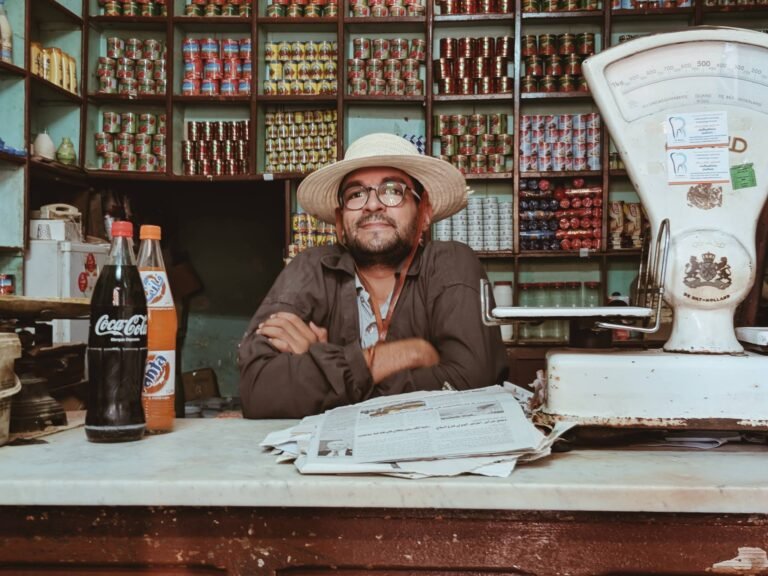
Let’s face it, you are Tunisian. Maybe you come across a Djerbian grocery store every day. This may seem very normal. Usually installed at the roadside, it is a grocery store like any other. Inside you can find different canned goods: tomatoes, tuna, chili and also rice packs and especially pasta.
When we see fresh groceries on our doorstep, it is so easy to forget the hard workers behind each product. But in this article we see things differently to unveil the secrets of the Djerbian grocery store empire.
In this spirit, the Djerbian grocer is a must in our neighborhoods and our culture. Moreover, the natives of the island of Djerba have created networks of grocery stores both in Tunisia and abroad. Even if they are competing with supermarkets, the Tunisian grocery stores remain very present and always render eminent services. This is the reason why Djerbian grocery stores still exist today, although the island now has many more supermarkets.
The business model of the Djerbian grocery store in brief
This professional specialization is deeply rooted in community culture, echoing traditions recognized by UNESCO’s Intangible Cultural Heritage. It has allowed local economic development and the individual to feel useful to his community.
When there is a partnership between someone who owns capital and another person who performs the work, both want to make the business as profitable as possible. A capitalist want to make as much profit as possible, while the worker would like to have enough income to do his or her job.
On the social ladder, in ancient times, there were four categories in this type of trade: “Ejerbi” (usually a family member at the beginning of his career and very young) started as an apprentice, then partner before becoming a tenant and then owner. The manager of the grocery store received half of the net profits, the other half going to the owner of the fund.
As for the owner of the “Hanout” (grocery store), he sees in his apprentice someone who will help him and eventually take over the family business. It is very important for him to know that his heritage will be preserved and revived.
The legend of Djerbien’s trading spirit
The commercial spirit of the Djerbian has become legendary. First in Tunisia where the term “Djerbien” has become synonymous with grocer. Ejerbi” (literally “Djerbien”): this is how Tunisians refer to the neighborhood grocer. Apart from the grocery store, the Djerbians are also mercers, merchants of fez fabrics, pottery, oil, etc… but almost always traders.
From Djerba … All Tunisia … France and then the rest of the world
Elsewhere, around the Mediterranean basin, where Djerbian emigrants have settled the most, the small stores called “Hanout” are famous: open day and night, they offer a range of products from food to hardware and medicinal plants.
“A statistical study carried out on the eve of the Second World War gives us information on the Djerbian sedentary as well as on the total number of Djerbian merchants working outside the island… The number of merchants working outside the island is 6452, of which 77 are Jewish and 6385 are Muslim, divided between the Sunni Malekites (living in the eastern part of the island) who own 80% of the grocery trade and the Kharejites of Wahabite-Ibadite tendency (living in the western part) who engage in other types of trade.
(According to a study conducted by Kamel Tmarzizet).
In France, city dwellers are familiar with this expression. If all the shops close, there is only one way to shop: “The Arab on the corner”, always open and with a well-stocked store. Even if today the supermarkets of the big brands invade the city centers and compete with the small grocers.
Well, this local Arab is very often a Djerbian!
The Djerbians were able to create an empire thanks to their innovative economic model and their discipline. They have managed to leave their mark on the world. The Djerbian grocery stores remain a major power in Tunisia with an unbeatable sense of work.
For more tips and insights, visit CoZi blog.