In recent years, the conversation around tourism in Tunisia has started to shift.
It is no longer only about visitor numbers, hotel capacity, or seasonal peaks. Increasingly, the focus is on sustainability, innovation, and ecosystem integration.
One initiative reflecting this shift is the TTL Lab (Tunisia Tourism Lab) in Djerba. A program designed not just to promote tourism, but to rethink how tourism interacts with entrepreneurship, innovation, and local stakeholders.
What many may not know is that the methodology used in the TTL Lab was inspired by the Naga Business Incubator approach, developed through a strategic partnership between CoZi and Committ Consulting.
This is not simply a story about a program.
It is a story about how destinations evolve.
A Methodology Rooted in Business Incubation
The TTL Lab did not start from scratch.
Its structure and working framework were inspired by the Naga Business Incubator model, a methodology co-developed by CoZi and Committ Consulting to support entrepreneurs in southern Tunisia.
The core principles of this approach include:
- Structured mentorship and follow-up
- Real-world problem identification
- Direct engagement with stakeholders
- Rapid validation of ideas
- Community integration from day one
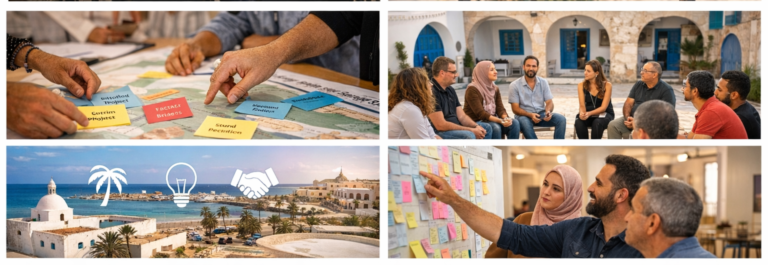
Rather than relying on traditional workshops disconnected from real-world challenges, the methodology emphasizes immediate immersion in the local ecosystem. Participants are directly connected with local actors, institutions, businesses, and community members from the outset, ensuring that their ideas are grounded in Djerba’s actual needs rather than remaining purely theoretical.
A Strategic Benefit for DMO Djerba and TTL Participants
An important element of the TTL Lab initiative is that the DMO Djerba (Destination Management Organization) and the program’s beneficiaries were able to benefit from this structured methodology free of charge.
This represents more than financial support.
It reflects:
- A commitment to destination development
- A transfer of expertise
- A willingness to strengthen local capacity
- A belief that ecosystem activation benefits everyone
By leveraging an incubation-inspired model, the TTL Lab delivered:
- Practical tools
- Strategic thinking
- Direct stakeholder access
- Faster idea maturation
For DMO Djerba, this reinforces its role not just as a tourism promoter, but as a facilitator of innovation within the destination.
Promoting Djerba Beyond Seasonal Tourism
Djerba has long been one of Tunisia’s most recognized tourist destinations.
However, like many Mediterranean destinations, it faces a key structural challenge:
Seasonality.
The TTL Lab contributes to a broader transformation:
From a destination known primarily for seasonal tourism
To a territory capable of generating year-round value.
By integrating entrepreneurship and innovation into tourism, Djerba moves toward:
- Diversified economic activity
- Stronger local businesses
- New service models
- Sustainable visitor experiences
Tourism is no longer just about hotels and beaches.
It becomes interconnected with startups, local producers, digital services, and community initiatives.
The Ecosystem as the Real Competitive Advantage
One of the strongest insights emerging from the TTL Lab experience is this:
Destinations do not compete only on natural beauty.
They compete on ecosystem strength.
In Djerba, this ecosystem includes:
- Local entrepreneurs
- Start-ups and innovators
- Business support organizations
- National stakeholders
- Public institutions
- Community spaces
When these actors are connected, tourism becomes more resilient and dynamic.
When they operate in silos, potential remains untapped.
The incubation-inspired methodology used in the TTL Lab helped create bridges between these actors, reinforcing collaboration instead of fragmentation.
Why Ecosystem Matters for Tourism and Business
A strong ecosystem benefits multiple dimensions:
For tourism:
- More authentic experiences
- Local value creation
- Reduced economic leakage
- Greater adaptability
For startups and entrepreneurs:
- Access to real market needs
- Visibility within the tourism sector
- Partnerships with established operators
For the destination:
- Year-round activity
- Increased attractiveness for investors
- Stronger territorial identity
Djerba’s future competitiveness will depend less on infrastructure alone and more on how effectively its ecosystem collaborates.
A Step Toward a More Sustainable Model
The TTL Lab represents more than a single initiative.
It reflects a broader ambition:
To position Djerba as a destination where tourism, entrepreneurship, and community development intersect.
By drawing inspiration from the Naga Business Incubator methodology — co-developed by CoZi and Committ Consulting — the program demonstrates how structured innovation frameworks can strengthen territorial development.
In this model, tourists are more than short-term visitors, entrepreneurs are not isolated actors, and institutions are no longer disconnected entities; instead, all become active participants within a shared and interconnected ecosystem.
Looking Ahead
Djerba already has natural advantages:
Climate, culture, history, and international recognition.
What initiatives like the TTL Lab demonstrate is that its next phase of development will depend on something deeper:
- Collaboration.
- Methodology.
- Ecosystem activation.
When destinations move beyond seasonality and invest in structured innovation approaches, they build resilience — not just visibility.
And that is where Djerba’s real opportunity lies.
For more tips and insights, please visit CoZi Blog.